
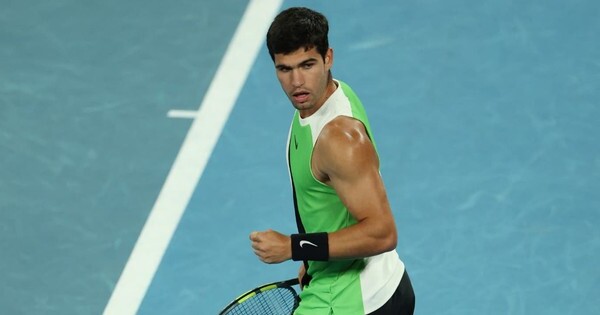
The Monte-Carlo Country Club delivered its final verdict on Sunday, April 13, 2025, and nobody who witnessed the week could call it ordinary. Carlos Alcaraz won his first Rolex Monte-Carlo Masters title by defeating Lorenzo Musetti 3-6, 6-1, 6-0 in the final, collecting his sixth Masters 1000 crown and his eighteenth career ATP title. The result opened a chapter that men's tennis had been waiting for: Alcaraz fully operational on European clay, ready to devour the dirt-court season with an appetite the sport has not seen since Rafael Nadal was at his peak.
Every analysis of the day, free
Create your free account to unlock today's analyses.
But reducing the 2025 edition to Alcaraz's triumph alone would miss what made the week genuinely compelling. Shocking early exits, spectacular comebacks, an unexpected finalist who reminded the world of his enormous talent, Monte-Carlo 2025 delivered the kind of theater that clay court tennis does better than any other surface.
The Fall of the Favorites: Djokovic and Zverev Eliminated
Before the draw took its final shape, two results shook the tournament to its foundations. Novak Djokovic, ranked sixth and a seven-time Masters 1000 champion, was knocked out in the second round by Alejandro Tabilo. The Chilean, who has steadily built a reputation as one of the tour's most dangerous floaters, produced a performance that confirmed a harsh reality: Monte-Carlo is no longer Djokovic's hunting ground. At 37, the Serbian must now manage a body that no longer responds with its former reliability, and the physical demands of Mediterranean clay amplify that truth in unforgiving fashion.
In the other half of the draw, Alexander Zverev suffered an equally swift exit. The German, seeded first and openly chasing the world No. 1 ranking, was stopped in the third round by Matteo Berrettini. The Italian, whose comeback from injury ranks among the most encouraging stories of the 2025 season, imposed his power game to send Zverev packing with serious questions about his clay court credentials. The defeat had direct ranking consequences: Alcaraz reclaimed the world No. 2 spot, a meaningful signal heading into the Madrid-Rome-Roland Garros stretch.
Jannik Sinner's absence also shaped the tournament in ways that deserve acknowledgment. The world No. 1, still serving his suspension through May 4, could not defend his 2024 semifinal points. His absence opened the draw considerably and deprived the event of the summit-level confrontation that fans craved. Monte-Carlo without Sinner felt like Roland Garros without Nadal: the prestige remained intact, but a central character was missing from the narrative.
Alcaraz vs. Fils: Match of the Year
If one match had to capture the spirit of this tournament, it was the quarterfinal between Carlos Alcaraz and Arthur Fils. The twenty-year-old Frenchman, riding a wave of crowd support and playing offensive clay court tennis of rare quality, took the first set 6-4 by imposing a tempo that Alcaraz had not anticipated. Fils struck the ball with a conviction that recalled the finest moments of French tennis on dirt, and for a set and a half, the possibility of a historic upset hung in the warm Monaco air.
Alcaraz, cornered, found the reserves that separate truly great champions from merely excellent players. He raised his level a full gear in the second set, winning it 7-5, before closing out the third 6-3 with passing shots struck from angles that only a handful of players on earth can execute under pressure. The ATP Tour later named it the 2025 Match of the Year, a distinction that faithfully reflects the intensity and quality of what unfolded on center court that Thursday.
Fils, despite the loss, emerged with his reputation enhanced. His game, built on racket speed and tactical intelligence, confirmed him as one of the tour's most exciting prospects and a future clay court contender of genuine substance.
Musetti's Run: From Obscurity to the Final
Lorenzo Musetti moved through the draw with the grace of a player who understands exactly what clay demands. The Italian, whose talent has sometimes been undermined by inconsistency across seasons, produced the most complete version of his tennis at Monte-Carlo. His quarterfinal against defending champion Stefanos Tsitsipas will stand as a textbook example of competitive resilience: trailing 1-6 after a first set in which nothing went right, Musetti rebuilt his game brick by brick, turning the match around 6-3, 6-4 with a clarity and patience that impressed even the most seasoned observers.
In the semifinals, facing Alex de Minaur, Musetti had to dig deep again. The Australian had produced one of the tournament's signature performances in the quarterfinals, a 6-0, 6-0 demolition of Grigor Dimitrov that was the first double bagel at Masters 1000 quarterfinal level since records began tracking such things. De Minaur took the first set 6-1 with the same cutting authority, but Musetti refused to fold. The Italian hung on, shifted the momentum, and eventually won 1-6, 6-4, 7-6(4) after more than two and a half hours. Victories like that, extracted from difficulty against an opponent in peak form, reveal a competitive character that Musetti had not always displayed.
His presence in a Masters 1000 final, the first of his career, gave this edition of Monte-Carlo a distinctive flavor. Musetti represents the strand of Italian tennis that blends aesthetic shot-making with intelligent point construction, a tradition that players like Adriano Panatta carried on these same Riviera courts decades earlier.
The Final: Alcaraz's Masterclass
The championship match began in the most unexpected fashion. Musetti, liberated by the extraordinary run that had brought him to the final, played a first set of remarkable quality. His down-the-line backhands, struck with the distinctive timing that has become his signature, unsettled Alcaraz, who appeared almost surprised by his opponent's boldness. The Italian took the opening set 6-3, and for a moment genuine doubt rippled through the stands.
What followed belongs in the category of demonstrations that only the very best produce when the stakes are highest. Alcaraz made a radical tactical adjustment between sets, increasing the depth of his groundstrokes and taking the ball measurably earlier. The result was emphatic. The Spaniard won the second set 6-1 and the third 6-0, leaving only crumbs for a Musetti overwhelmed by the acceleration in pace. Twelve games to one across the final two sets, the numbers require no additional commentary.
This ability to transform an uncomfortable position into a display of dominance is arguably the most impressive characteristic of Alcaraz's game. Where other champions take time to recalibrate, the Spaniard shifts from one level to the next with a speed that leaves opponents stranded. Musetti, for all his quality, simply did not have the weapons to withstand that escalation.
Davidovich Fokina: The Quiet Semifinalist
Beneath the tournament's bigger storylines, Alejandro Davidovich Fokina delivered a week of genuine quality. The Spaniard, often underestimated on tour, reached the semifinals by beating Alexei Popyrin 6-3, 6-2 in the quarterfinals with an authority that deserves recognition. His clay court tennis, built on rhythm variation and relentless defense, allowed him to navigate the draw with impressive efficiency.
His semifinal against compatriot Alcaraz, decided 7-6(2), 6-4, produced an all-Spanish contest of high quality. Davidovich Fokina matched the eventual champion for a set and a half, yielding only after a tiebreak in which Alcaraz produced some of his best shots of the tournament. The run confirmed Davidovich Fokina as a clay court operator capable of performing at the highest level when conditions align.
De Minaur's Double Bagel: A Statistical Earthquake
It would be unfair to pass over the week's most statistically remarkable performance. Alex de Minaur, the Australian whose game is more commonly associated with hard courts, inflicted a 6-0, 6-0 defeat on Grigor Dimitrov in the quarterfinals. That scoreline is vanishingly rare at this level of competition, rarer still in a Masters 1000 event. De Minaur played tennis of clinical perfection that day, offering the Bulgarian absolutely no daylight as Dimitrov appeared paralyzed by the speed of execution opposite him.
The victory, the most emphatic of de Minaur's clay court career, confirmed the evolution of a player who has steadily expanded his game across surfaces. His semifinal loss to Musetti does not erase what he showed at Monte-Carlo: a competitor capable of producing elite-level performances on any surface he plays.
What Monte-Carlo Tells Us About the Clay Season Ahead
Alcaraz's victory belongs in a context larger than any single tournament. The Spaniard proved he can dominate European clay with the same authority he displays on hard courts and grass, completing a player profile that men's tennis has not seen since Djokovic was at his absolute peak. His planned run through Monte-Carlo, Madrid, Rome and Roland Garros represents the royal road of the clay season, and after this first Monegasque title, every opponent in his path knows the Spaniard is arriving with the confidence and physical condition of a champion operating at full capacity.
For Italian tennis, the week offered a mixed but broadly positive outcome. Musetti reached his first Masters 1000 final, Berrettini proved his comeback is genuine, and Sinner, though absent, remains the undisputed world No. 1 who will return to competition in May.
The 2025 Monte-Carlo Masters will be remembered as the tournament where Alcaraz laid the first stone of what promises to be a sustained assault on clay court supremacy. The shark showed its teeth on the Riviera, and the rest of the dirt-court season looks very much like his hunting ground.