
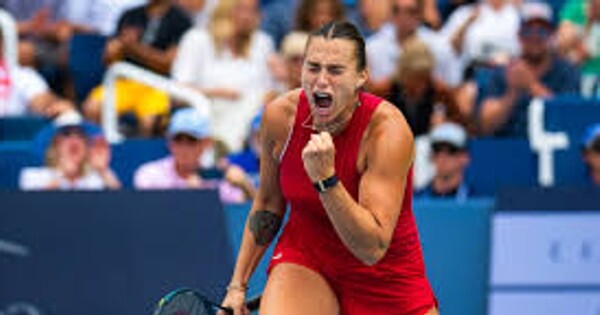
The Wimbledon 2026 women's draw has produced the matchup everyone wanted. Aryna Sabalenka, the top seed, will face Naomi Osaka, the fourteenth seed, on Sunday in the fourth round. Two pure power players, two diametrically opposed trajectories, one court.
Every analysis of the day, free
Create your free account to unlock today's analyses.
Sabalenka enters this clash with the composure of a player in full command of her game. Her 6-4, 6-4 victory over Jelena Ostapenko in the third round was a masterclass in efficiency: nine aces, just six unforced errors, 71% of first-serve points won. The Belarusian even managed a brief Ostapenko fightback in the second set after leading 4-1 with a double break, wrapping up proceedings in 92 minutes. "I'm happy with my level, I would say eight out of ten," she had said after her second round. This Wimbledon marks a significant milestone in her pursuit of the only Grand Slam title missing from her collection.
Across the net, Osaka carries an entirely different narrative. Her 6-1, 6-3 demolition of Kasatkina represents far more than a routine passage into the next round. It marks the first time in thirteen years of professional tennis that the Japanese star has reached the Wimbledon fourth round. A glass ceiling shattered after five unsuccessful attempts at the third-round stage. Since arriving in London, Osaka has conceded just fifteen games across three matches, a sign of renewed confidence on a surface long considered her weakness.
The head-to-head tilts firmly in Sabalenka's favour. The Belarusian leads 3-1 in their recent encounters and has won the last three consecutively. A genuine psychological edge, even if Osaka has proven she can reinvent her approach against the very best.
What makes this duel so compelling is the symmetry of style. Both players rely on raw power tennis: devastating serves, heavy forehands, relentless aggression. But their trajectories diverge. Sabalenka, twenty-eight, stands at the peak of her career, a solid world number one for over a year. Osaka, also twenty-eight, is rebuilding hers after motherhood and months of uncertainty.
On grass, this contest takes on a particular dimension. It will be their first meeting on the surface. Sabalenka has demonstrated remarkable adaptability in recent seasons, reaching the Wimbledon semi-finals last year. Osaka, meanwhile, has found new life on the lawn through the work of coach Tomasz Wiktorowski. "He tells me to trust my instincts and keep moving forward," the Japanese player explained. An attacking approach that could unsettle Sabalenka if Osaka maintains her current level.
The key factor will be the serve. Sabalenka possesses one of the most formidable serves on tour, capable of suffocating any opponent's return. But Osaka, with five aces and zero double faults against Kasatkina, showed she too can wield that weapon with surgical precision on grass.
On Sunday, likely on Centre Court, this fourth-round encounter will feel like a quarter-final played early. For Sabalenka, it represents a step towards the title she still lacks. For Osaka, it is the chance to prove her renaissance extends beyond sentiment and translates into results against the world's best.