
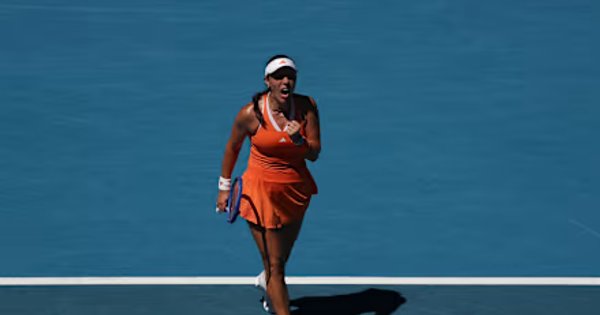
There are stories in professional sport that nobody would dare to fabricate. Jessica Pegula's is one of them. Her father, Terry Pegula, built a fortune exceeding seven billion dollars from the natural gas industry, bought the Buffalo Bills and the Buffalo Sabres, and turned the family name into a byword for American sports wealth. Jessica could have spent her life in the owner's box. Nobody would have blamed her. Instead, she chose the professional tennis tour, a grinding, unforgiving circuit that does not care whose name is on your trust fund. At thirty-one, she remains one of the most consistent players in the women's game, a 2024 US Open finalist, a three-time title winner in 2025, and a fixture inside the world's top ten. None of it was handed to her.
Every analysis of the day, free
Create your free account to unlock today's analyses.
Born on February 24, 1994, in Washington D.C., Pegula grew up surrounded by sport but not by tennis specifically. Her father had started East Resources with a $7,500 loan in 1983, drilling for natural gas in Pennsylvania. The Marcellus Shale formation turned that modest bet into a goldmine. In 2010, Terry sold the bulk of his assets to Royal Dutch Shell for $4.7 billion. The Sabres followed in 2011, the Bills in 2014 for $1.4 billion. By the time Jessica was establishing herself on the ITF circuit, her family had become one of the most powerful sports dynasties in North America.
The wealth bought access and comfort, but it could not buy a backhand or a ranking. Pegula's early career was defined not by privilege but by physical breakdown. A knee injury in 2014 took her off the tour for eighteen months. The comeback was slow, the results modest, the ranking stubbornly low. Then came the blow that nearly ended everything. In 2017, a torn labrum in her hip required major surgery. For the second time in her young career, she was sidelined for close to a year. Her ranking cratered beyond 800 in the world. Three months of daily rehabilitation. Doubt about whether the effort was worth it. She admitted publicly that she did not know if she wanted to come back.
This is the detail that separates Pegula from almost every other player on tour. Most professionals are driven, at least partly, by economic necessity. Tennis is their livelihood, their route out, sometimes their only option. For Pegula, every hour in the gym, every physio session, every flight to a low-level tournament in an unremarkable city was a choice she made freely. She played because she loved the sport and because she had something to prove, perhaps first of all to herself.
The breakthrough arrived late. In September 2018, at twenty-four, she reached her first WTA final in Quebec City. By February 2019, she had cracked the top 100 for the first time. Her maiden WTA title came in August 2019 at the Washington Open, where she beat a young Iga Swiatek along the way before dismissing Camila Giorgi 6-2, 6-2 in the final. She was twenty-five. In a sport increasingly dominated by teenagers, Pegula was only just getting started.
The real explosion came in 2021. Starting the year ranked 62nd, she finished inside the top 20, powered by five Grand Slam quarterfinals, multiple semifinals, and regular wins over top-ten opponents. The Pegula machine had started, and nobody could ignore it any longer. In 2022, she claimed her first WTA 1000 title at the Guadalajara Open and reached a career-high ranking of world number three in October.
While her career climbed, her family faced a crisis that no amount of money could solve. In June 2022, her mother Kim Pegula suffered cardiac arrest in her sleep. Jessica's sister Kelly performed CPR, using skills she had learned only three months earlier for a job requirement. Kim survived, but the damage was severe. Significant expressive aphasia. Serious memory problems. A likely inability to return to her roles running the family's sports franchises. Jessica kept the news private for eight months before writing about it with raw honesty in The Players' Tribune. Her mother could read, write, and understand, but struggled to find words to respond. The piece landed with an emotional force that reached far beyond the tennis world.
The ordeal did not slow her down on court. The 2023 and 2024 seasons cemented Pegula as a permanent member of the elite. Back-to-back Canadian Open titles, a feat last achieved by Martina Hingis in 1999-2000, confirmed her hard court dominance. Quarterfinal runs at all four Grand Slams made her one of the most feared names in any draw.
Then came September 2024 and the US Open. Pegula's run through Flushing Meadows had the quality of a player operating in a state of grace. Round after round, she dismantled quality opponents with a solidity that bordered on the mechanical, reaching her first Grand Slam final. Against Aryna Sabalenka, she fought hard, losing 5-7, 5-7 in a match decided by margins. The defeat stung, but the statement was unmistakable. At thirty, Jessica Pegula belonged among the players capable of contesting a major title.
Her playing style explains much of her longevity at the top. Pegula is not a power player. She does not possess Sabalenka's devastating serve or Swiatek's crushing forehand. What she does possess is tactical intelligence that sits above the tour average and an ability to neutralize opposing weapons that makes her a nightmare to play against. Her court position is distinctive. She is close to the baseline as she can get away with, on return and in rallies, refusing to back up against deep drives or high bounces. She picks the ball up on a short hop or reaches above her shoulder rather than retreating. This aggressive positioning lets her take the ball early, compress her opponent's reaction time, and impose a suffocating tempo.
On hard courts, her preferred surface, this approach becomes formidable. Seven of her ten career titles have come on hard courts, including all four WTA 1000 crowns. She has explained it with characteristic directness. The true bounce of hard courts lets her find her rhythm quickly. Her flat, deep ball skids through the court. Unlike clay, which absorbs and slows, hard courts reward her early ball-striking and precision placement.
But labeling Pegula a hard court specialist became outdated in 2025. Three titles on three different surfaces, a rare achievement on the WTA Tour. Austin on hard. Charleston on clay, her first title on the red dirt. Bad Homburg on grass, where she beat Iga Swiatek in straight sets in the final. This new versatility revealed a player still evolving at an age when most careers have plateaued, adapting her game to each surface's demands without losing her tactical identity.
The 2025 season as a whole was among the finest of her career. Fifty-three match wins. Six finals, three of them won. Runner-up finishes in Adelaide against Madison Keys, at the Miami Open, and in Wuhan against Coco Gauff. A US Open semifinal where she pushed Sabalenka deep once again. A year-end ranking of world number six, her fourth consecutive top-ten finish. The numbers paint a picture of a player who simply does not get tired, who stacks competitive weeks with a mechanical regularity that her rivals struggle to match.
The wealth question follows Pegula everywhere. Social media never misses a chance to point out that her parents own a yacht reportedly worth a hundred million dollars, that her family could buy most sports franchises on the planet. Some call her a nepo baby, a reductive term that erases years of physical suffering and hard work. Others question whether her results carry less weight because she never needed the prize money.
Pegula has addressed the noise with a blend of candor and irritation that suits her. She acknowledges the privilege freely. She knows she never had to worry about funding her next flight or her next coach. But she also points out that money never hit a ball for her, that her two surgeries hurt no less because her family was wealthy, and that Grand Slam losses sting just as badly in a presidential suite as in a budget hotel.
Off the court, she has built her own identity separate from the family empire. In 2018, she founded Ready 24, a skincare brand aimed at active lifestyles, alongside her husband Taylor Gahagen, whom she married in October 2021 at the Biltmore Estate in North Carolina after six years together. The couple also started A Leading Paw, a nonprofit dedicated to training rescue dogs as service animals. These ventures, modest against the backdrop of family wealth, reflect a desire to build something that belongs to her alone.
At thirty-two in February 2026, Jessica Pegula represents a form of resilience that the tennis world increasingly respects. She does not have the Grand Slam trophy count of a Sabalenka or a Swiatek. She does not have the youth of a Gauff or the raw power of a Rybakina. What she has is determination forged through adversity, a game built on intelligence rather than force, and a career that proves there are no shortcuts in elite sport, even when you can afford them. The billionaire's daughter stole nothing. Every win, every ranking, every final was earned point by point, through pain and effort. That may be what makes her story, paradoxically, more inspiring than that of any player who started with nothing.